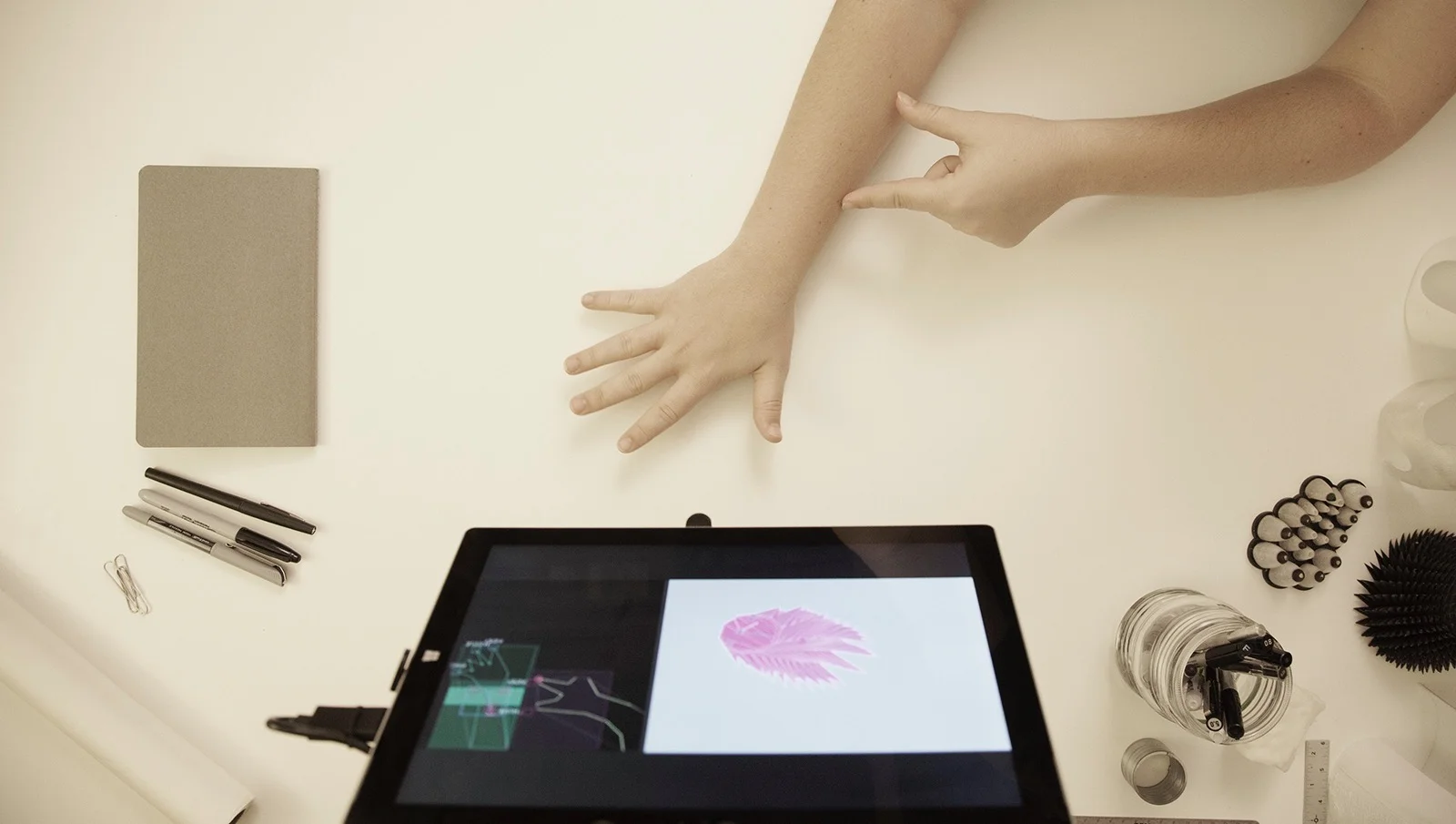
Merging digital processes in design with physical processes in fabrication through bespoke vision-based modeling software for 3D scanning / sensing / printing / scanning / sensing / printing / scanning / sensing / …
Reverberating Across the Divide was presented as a part of [en]CodingArchitecture 2013: A Conference on the Autonomy of Architecture, Robotics, Fabrication, Code, Machinic Desire, and Computational Theory.
Madeline Gannon has been invited to give a lecture as apart of the Spring Lecture Series of Florida International University’s School of Architecture. Her lecture, THIS COULD GET WEIRD, discusses our changing relationship with the built environment as digital technology & culture becomes increasingly pervasive in everyday experiences.
Miami, FL February 28th, 2013 at 5pm
madLab was invited to lead a 3 day intensive workshop in physical computing for Florida International University’s School of Architecture. Over 22 hours, 18 students and 3 professors learned the foundational knowledge necessary for translating physical input into meaningful embedded interaction with the built environment, including soldering, electronics, programming, hacking, and debugging.
SeaLegs, a responsive environment for Mollusk-Aided Design, harnesses the power of a simulated virtual squid to generate baroque and expressive spatial forms.
As the creature’s movements are traced through space and time, its familiar squid-like motion aggregates into unexpected, intricate forms that are immediately ready for 3D printing.
Machine Drawing Drawing Machines, a project with Pablo Garcia, is a narrative folio in which the patents of 12 historically significant drawing machines are recreated with an industrial Computer Numerical Control (CNC) machine. The use of a highly specialized CNC machine demonstrates a level of detail and accuracy that the last five centuries of drawing machines could only aspire towards.
madMeshMaker is a generative modeling environment that bridges the processes between digital design and digital fabrication. The app embeds the technical knowledge of an experienced fabricator within an intuitive interface, and allows any novice to CAD/CAM processes to rapidly generate aesthetically pleasing, ready-to-fabricate forms at the click of a mouse.
madLab was commissioned to digitally fabricate the signage for Conflict Kitchen’s Venezuelan iteration, “La Cocina Arepas” . Conflict Kitchen is a take-out style restaurant that rotates it menu, facade, and cross-cultural dialogue every four months to highlight the cuisine and culture of countries with which the United State is in conflict. La Cocina Arepas is the third installment of the kitchen’s mission.
With the relative novelty of the KINECT, this speed project with Marynel Vázquez responsed to its inherent screen-based interaction was to pull it back out into the physical realm. Using the depth mapping capabilities of the KINECT to evaluate the viewer(participant’s) hand, and position it as the light source of the physical model. In effect, their hand becomes the sun, lighting or dimming our abstracted cityscape, and blurring the border of virtual and actual.
Pattern && Symmetry is a project that explores how generative design tools can create infinite variations on a single series. This is in contrast to conventional distribution of an artist’s or designer’s work, which is serially replicated to create an edition, rather than a collection. Each iteration is characterized by its geometric densities, creating topographies that seem to extend beyond the depth of the two-dimensional paperboard.
The latest version of the madMeshMaker was used in a workshop introducing digital fabrication in architecture to the 16 and 17 years olds participating in CMU’s School of Architecture PreCollege Program. The 20 students generated over 200 digital models over the 30 minute hands-on session. 20 of the meshes were then digitally fabricated to be installed as a part of the student’s final project, a DJ Booth / Party Space.
madLab will be traveling to Miami, FL this July as an invited critic for PROJECT 41: A Tale of Cities … that Share One Street. Presentations will review the nomadic design studio’s investigations into novel techniques in urban documentation and speculative mobile infrastructure. Project 41 is coordinated studio between the Department of Urban Speculation at the University of Illinois Chicago and Florida International University’s 4th Year Architecture Studio.
A collection of objects rapidly designed+fabricated with the madMeshMaker app: a wall paneling system that combines the textural qualities of it’s wooden-form with the tactile qualities of the plastic, a graphic poster that explores dynamic spatial associations created through intricate macro and micro patterning, and a book/laptop/iPad stand and tiles that leverage the material properties of laminated birch plywood to explore topographic patterning and symmetry.
The madMeshMaker was featured in an introductory workshop on digital fabrication for Carnegie Mellon University School of Architecture Freshmen. The 4 hour workshop centered around teaching integrated digital design and fabrication techniques for the school’s 4-axis CNC router, and providing a platform for the students to discover the discrepancies between the virtual model and physical object throughout the process.
The madMeshMaker is a generative surface modeling environment, intended to be an intuitive and fun introduction to digital fabrication with computer-numerically-controlled (CNC) table routers. The main intention of this software application is to erase the technical barriers-of-entry for digital design and digital fabrication (CAD/CAM) technologies, and therefore enable those without experience to quickly learn through making.
Initial prototypes are being developed to investigate architectural surfaces that engage the human body in dynamically transforming the space around them. The Grotto Ceiling senses the presence of the person below, rising and falling in response to their position, and inspiring new relationships between the body and the surfaces that encompass it in space.
As design and architecture professions become increasingly intertwined with digital production processes, the most fundamental design tool, the pen, is being replaced by the mouse. Graphic tablets and styluses are helping to bridge the gap between the analog and digital realms of design and creativity, however, they are often cumbersome to both learn and use. This project with Ziad Ewais develops a stand-alone application that will improve a user’s ability to freehand draw with the tablet, thereby increasing coordination from design ideas to the computer interface.